Mina Witteman – author | editor | teacher of creative writing

Time To Say No

Posted on November 19, 2012

A big chunk of my writer friends ‘do’ NaNoWriMo again this year, National Novel Writing Month. I suspect most people are familiar with the concept: write a novel of at least 50,000 words in one month, starting November 1 and ending November 30. Some of my friends breeze through this year’s NaNoWriMo, others struggle with every word.

Me?
I’m skipping NaNoWriMo altogether. Not because I don’t like challenges. I LOVE a good challenge. I LOVE to win, too, and in the run-up to NaNoWriMo, I was filled with eager anticipation. Another chance to push out a novel, another chance to show that I have a writer’s stamina, an artist’s perseverance. While thinking up a plot for my next NaNoWriMo novel, I took a good look at my desk. I do that, because sometimes even the tiniest shred sparks an idea. My desk was –and still is– packed with newspapers, magazines, books, cards, nicknacks, maps. And with projects. I am working on a thriller for adults, on a YA thriller, on the English translations of my previously published books, on three picture books, an article for my coming graduation  as a creative writing teacher, my bi-weekly homework for school, a series of ultra short stories, the organization of an EU-wide SCBWI conference in Paris next March.

I looked at it all and I thought: 

That is why my NaNoWriMo profile shows that I entered this year’s challenge, but that my word count is still a liberating 0. I will finish all my projects first and next year… well, next year is 12 months away. We’ll see how my desk looks like then and if there is room for another NaNoWriMo challenge. For now I can tell you that it feels good to say no once in a while.

Let Your Inner Critic Speak

Posted on November 17, 2012

It’s almost done, the course Teaching Creative Writing. We have just a couple more months to go before graduation. Today we had a masterclass from a colleague writer/teacher focussing on the ‘guerilla between the writer and the creative writing teacher’.

We started the day with an extraordinary writing exercise. One that kinda freaked us out, like a walk in the Paris catacombs can freak you out.

You all know about the inner critic, that nagging voice in the back of your heads that persists in telling you that you suck, major league. Like most of us, I have learned to silence that voice, trick it into believing that I am not interested in its musings. But silenced or not, it is always there, lurking in the darker crevices of my mind, ready to pop up when it senses even the slightest crack in my defence wall. Ready to pull the rug from under my writer’s chair. Today our colleague asked us to listen to that voice, let it speak unhindered, and write down what it said. No censorship allowed. We looked at each other, some with fear in their eyes, others with quiet resignation.

I sat down and wrote.

Then something unexpected happened: the longer I listened and the more I wrote down what it said, the more hilarious the voice became. I had never recognized my inner critic to be such a pompous fool, such a comedian, such an exaggerator. I had never realized that my inner critic is just as much the fictionist as I am.

It was an amazingly fruitful and freeing exercise. A revelation. By letting my inner critic honk away it turned into a cackling goose. I can choose to listen to it and have a good laugh, I can tell it to dip its pea brain into the waters and eat duck weed. It has lost its power.

No three-letter-words

Posted on November 16, 2012

Daily prompt prompts me to write an entire blog post without using three-letter-words. A true challenge, particularly to a foreigner like me. Could I do that? An entire post without a single three-letter-word? We will discover quickly.

When procrastinating my days away on the internet, I came across this wonderful blog post by Shaun Levin. Shaun is an English writer. He is also a writing teacher, always exploring ways to inspire students, ways to inspire himself. When Shaun designs writing courses, he bases them on a premise: through direct experience of a city writers deepen their understanding, their experience of a sense of place, they become more aware of a city’s relevance to whichever prose genre. By writing, eating, walking, floating around a city, by being away from their desks, writers will discover strangeness in familiar objects or well-known events.
To help writers to enrich their writing with finding other ways of using built or natural landscapes, Shaun came up with an absolute brilliant plan: Writing Maps. Maps that guide writers through a city of inspiration, past characters, even through their writing life.

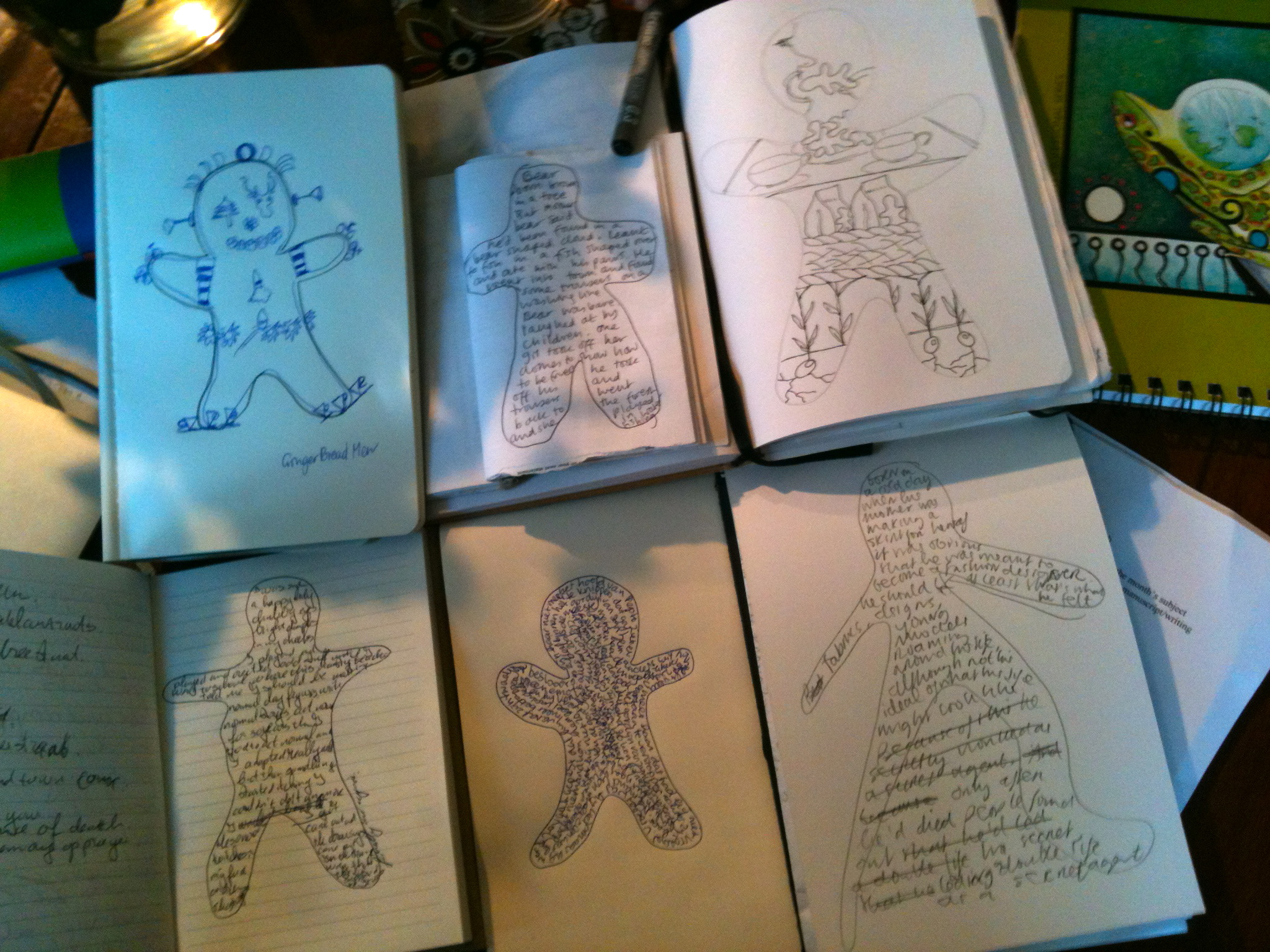
I ordered Shaun’s maps by sponsoring Shaun’s Writing Maps Indiegogo project. Last week, I received a first collection of maps. I used them with SCBWI’s Amsterdam Critique Group, last Sunday. We loved them! Look at what we accomplished with a simple writing prompt as ‘write your character’s entire life story in this shape’:

Writing Maps: A Character’s Life

Neat, eh?

Interested in Shaun’s Writing Maps, go to Write Around Town!
To order writing maps, go to Writing Maps!

Found three-letter-words? Tell me!

When protagonists rock your manuscript

Posted on October 4, 2012

Sometimes it feels like this writing business is a never ending story. Is there any time that a writer can say goodbye to his manuscript and send it off with a feeling of having pulled off something good? I doubt it. For me, it seems almost impossible. 

I have been working on this manuscript – ICARUS’ DOOM – for a while now. The first version I rejected myself, the second version was manhandled (in a good way!) by my publisher friend, my agent and my critique partners, and still the third version didn’t quite turn out the way I wanted it. The story was there. It was a good story, a thrilling story, but something was off. I twisted it, I turned it. To no avail.
Was it the language? I knew that was a tough call. It was my first manuscript written in English. I wasn’t too worried about that when I started. Wasn’t it Hemingway who said: “Poor Faulkner. Does he really think big emotions come from big words? He thinks I don’t know the ten-dollar words. I know them all right. But there are older and simpler and better words, and those are the ones I use.” Beckett even wrote in French to simplify his style. 
It wasn’t the language. Although not as sophisticated as I had hoped, I could live with that. There was something more fundamentally wrong with the manuscript. I puzzled over it and I talked it over with whomever was willing to listen. It didn’t come to me and I was about to chuck the whole thing in the bin.

But then my dear friend and colleague came to the rescue: Steve Bramucci. Steve spent a month in Amsterdam this spring and we had some excellent writing sessions at the library. When I told him that I was about to throw in the towel, he said I couldn’t. It was a good story. One that needed to be told. Steve gave me a simple assignment in stead: write a scene from the point of view from each of your main characters. I told him I would try, found myself a good spot in the library and wrote a short scene from Dorian’s POV, a scene from Jimmy’s POV and one from Pepto’s POV. That simple assignment turned out to be a revelation. I had been writing the story from the wrong point of view. It wasn’t Dorian who was my protagonist. He was the victim in this story, the prey, the fall guy. It wasn’t Jimmy, either. It was this weird and mysterious guy Pepto. He was my main man. 

Now, I am almost done with the next version, which in a way is a first version again, as changing the protagonist tilted the story in so many ways that it feels like writing a whole new story. 

I will tell you more later, because changing protagonists wasn’t all I found out that afternoon at the library. Just be assured that writing IS a never ending story! And I am happy for that. 

Image


Listening while writing

Posted on August 1, 2012

Would that work, I wondered, listening while writing? I listen to music when I write. Often. Sometimes to cheer me on, sometimes to land me in another world, sometimes to up the tension. Music without lyrics usually, because lyrics tend to mess up my words.

ImageWhen a colleague creative writing teacher posted a link to THE NEW YORKER Fiction Podcasts I hurried over to the site. Writers heaven, I tell you. Writers heaven! A monthly reading and conversation with The New Yorkers fiction editor, Deborah Treisman. Every month an author reads a short story written by another author. They pick the piece themselves, talk it over with Treisman and then they read.

I downloaded the available podcasts through iTunes and listened to the first, to the second. And then something strange happened. While listening to the second story and without actually noticing I had opened Scrivener and started writing. I am currently reworking ICARUS’ DOOM. Listening, I had completely faded out of the story that was being read, the deep voice, the intonation, the flow of words bringing me into a writing trance like I was listening to Glass’ Mishima or to Bach’s Das Wohltemperierte Klavier.

When I read back what I had written, I was pleased with the result. It had nothing to do with the story I had been listening to, but somehow those words sounding in the background had given me a tremendous boost. As if listening to an English-speaking voice kind of landed me in the States and made writing in English easier, more natural.

How does that work for you? What sends you into a trance? Is it music? Silence? Words?

Whatever it is, do check out the Fiction Podcasts of The New Yorker. They are a gem!

Writers’ Workshop in Amsterdam

Posted on May 20, 2012

SCBWI Illustrator and Writer Workshops in Amsterdam

Posted on March 23, 2012