Mina Witteman – author | editor | teacher of creative writing

Helpless

Posted on January 7, 2013


Helpless. It is how I felt during 2012, with so many people I dearly loved passing away. With every death my creativity died a little, too, until I felt I had lost all connection with my projects, with my writing. It left me helpless and I had to shelve manuscripts and translation efforts. The creative juices simply stopped flowing. 

Would I ever write again, I wondered? Get those juices flowing again?


Image


Yes! I just had to remember all the good things in life, too, even if they were into deep hiding, like the Trapajon guy in his tree. I had to reach inside and pull out the good times: my son graduating from High School, a short children’s story published in an anthology, another one accepted to be published this January. The publication of an ultra short story in the anthology 220W next to the short stories of a couple very famous Dutch writers. The completion of my graduation portfolio.

Thinking about the good times bounced me right back into the balance and slowly but surely the creative juices are starting to flow again. I will finish that manuscript. I will finish those translations. And when I look at the fellow up in the picture, my mind starts whirling, thinking up new stories and new projects already.

2013 will be a good year!


Writerly New Beginnings

Posted on December 31, 2012

May 2013 be filled with love and words and words you love!

photo

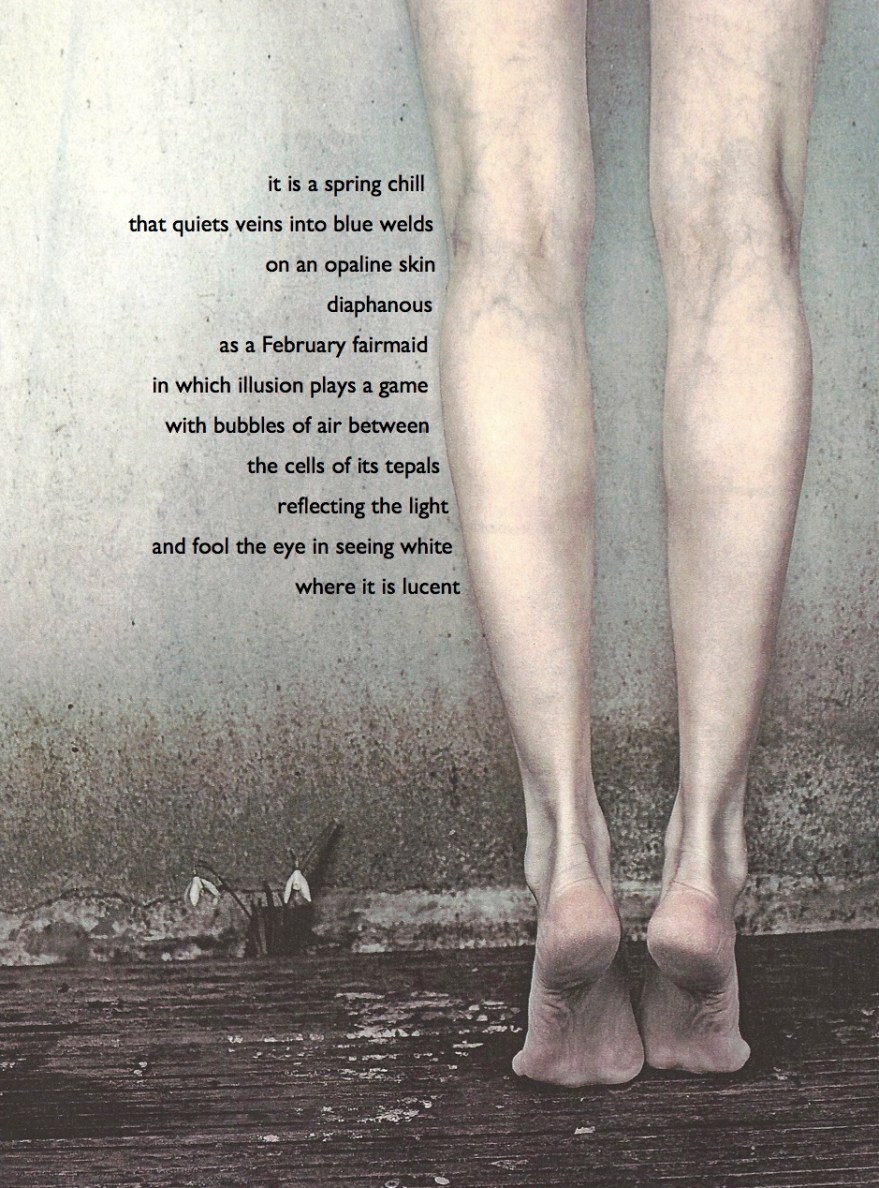
Picture Poem

Posted on December 28, 2012

New Year

220W — 220 Flash Fiction Words

Posted on November 26, 2012

It seems that the popularity of ultra short stories is on the rise. Events with famous writers of short stories, like the brilliant and funny A.L. Kennedy, and — to me — the empress of the short story Lydia Davis prove it. I like that, because I have this thing going for flash fiction. I love reading it and I love writing it. Writing with a constraint on word count forces you to zoom in on the very essence of your story. It pushes you to be terse. It allows you to rip out every empty word.

No more than 220 Words.

That was the prerequisite to enter the contest for the A.L. Snijders Award for Flash Fiction 2012. I had the story in a flash, wrote it down, sat back and let it simmer for a while. And then I got to work. I sharpened my pen and my brain, and started cutting until I had it down to perfection; my story ‘Niet anders’ (‘Unchanged’). I took a deep breath and sent it in. So did over 300 people and a total of 422 stories arrived at the jury’s desk.

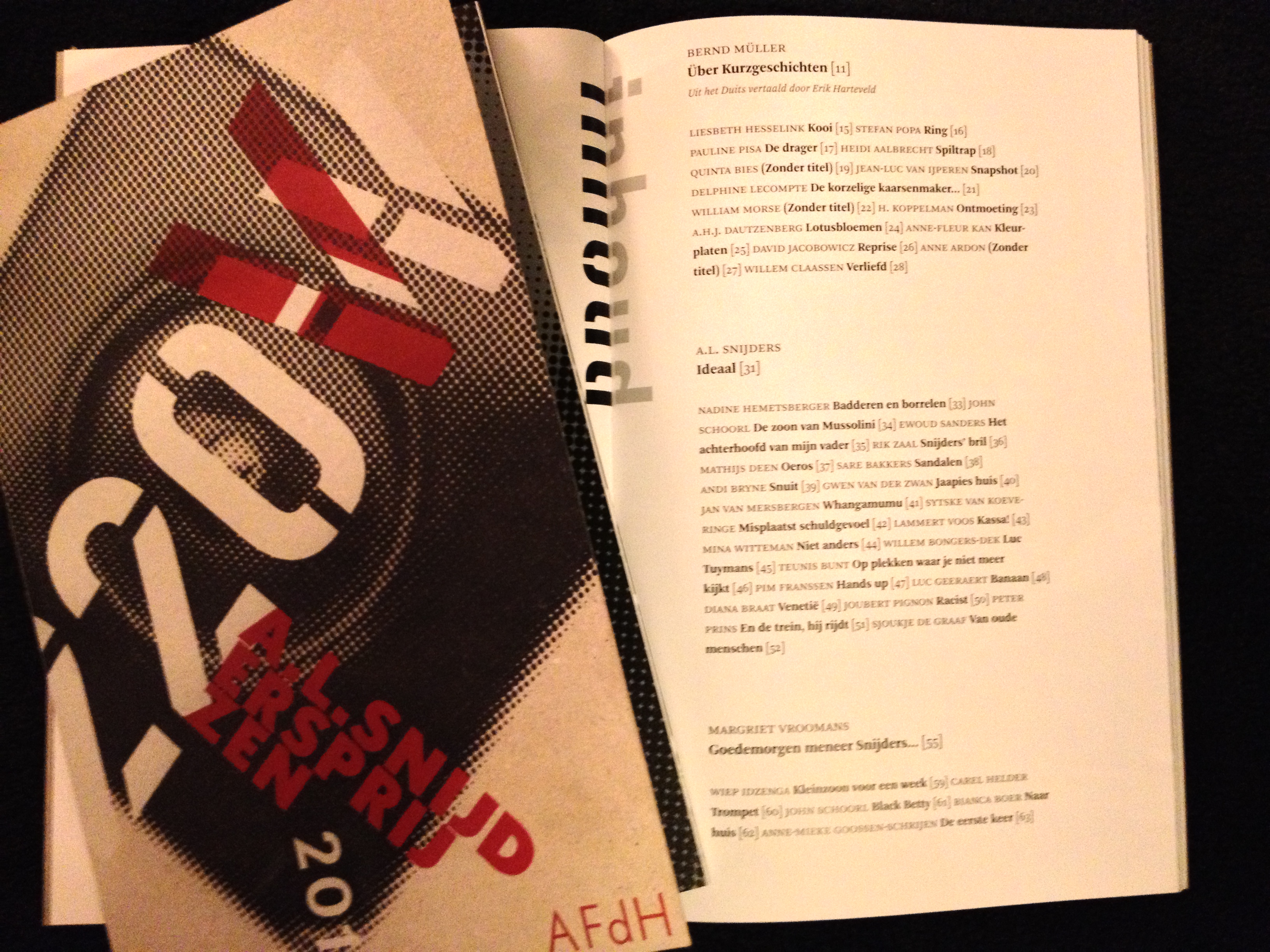
Mina Witteman – Niet anders – page 44

‘Niet anders’ didn’t win, but it was chosen by the editors of AFdH Publishers as one of the stories that “made it far”. It was therefore included in the anthology that is now published in honor of the award and aptly titled 220W.
I am honored to have my story published in an anthology with the Dutch grandmaster of the ultra short story A.L. Snijders and famous Dutch writers like Wim Brands, Ewoud Sanders, A.H.J. Dautzenberg and Jan van Mersbergen.

For those who read Dutch: it is for sale at bookstores.

I just realized this post makes an excellent example for the daily prompt Success!

Connect the Dots

Posted on November 24, 2012

Another prompt from The Daily Post: Open your nearest book to page 82. Take the third full sentence on the page, and work it into a post somehow. I suspected a hard one as I am reading ‘The Cambridge Companion to Creative Writing’, doing research for my graduation article. We’ll see…

I had been teaching creative writing for quite a while, mainly workshops and short courses, mostly to young people. One day I found myself standing before a particularly challenging class. Fifteen boys sized me up and said: “Writing? Seriously?” They sat back, folded their arms and waited, their body language screaming “no way”. The girls — an ominous thirteen of them — looked up, too. “You’re not Carrie Slee,” was all they said. Disdain dripped off their words. Carrie is the Dutch Ellen Hopkins, a tremendously popular writer of edgy YA. Their words were like trip wire, landing me flat on my face and blowing the workshop to shreds. I pledged myself to never let that happen again. I would go back to school and add a nifty set of didactic tools to my teaching and writing toolbox. Next time, I would detect and step over the wire like James Bond himself.

These past three semesters I spent my time learning and teaching, designing writing exercises and classes, developing creative writing courses. Arduous but eye-opening times. I not only gathered a wealth of didactic tricks and tips, I also broadened my writing skills, schooling myself in poetry and flash fiction. And now, writing my graduation article, I am “Binding it all together: a study in process”.

There you have it, page 82, the third full sentence of The Cambridge Companion to Creative Writing in Bronwyn Lea’s entry ‘Poetics and poetry’.

Check it out if you like to know more about teaching creative writing. My favorite is the contribution: ‘Does that make sense? Approaches to the creative writing workshop’ by writer, teacher and comedian A.L. Kennedy.

Bart Moeyaert: Introspection as a state of motion

Posted on November 22, 2012

Bart Moeyaert is one of the most famous, if not the most famous of writers in the Dutch language. He writes novels and short stories, for adults and children alike. I love his work, I love his thoughts, I love the way he provokes thoughts. We had the privilege of having him teach a masterclass at our school, early November. If you are looking for inspiration… you will find it with him.

Sit back and listen to his address at TEDxFlanders, where he talks about silence and introspection.

What Would a Guy Do?

Posted on November 21, 2012

A couple days ago I skipped past my inner critic. It was a truly liberating feeling knowing that I can easily bypass that nagging voice.

Freed from my inner constraints, I moved on to the next project. I sat down to research my graduation article “Collaborative Writing, Contradictio In Terminis?” and maybe push out the first paragraphs. For that, I reread an article sent to me by colleague writer and creative writing instructor Chris Eboch. A line in that article triggered me. Chris writes about two colleagues who formed an online group. When they discovered that male writers were much better at supporting themselves as a writer, they began to ask themselves ‘What would a guy do?’ The positive results of their question soon showed in their income.

I linked that information back to my writing life. Everywhere I come and writers are gathered — be it conferences, workshops, courses, online groups, guilds or associations — the majority of the attendees is always female. And yet, there don’t seem to be more published female writers than male writers (this is a gut feeling, not a scientific fact).
It made me wonder where guys go for support. Do they actually need support? Or are they so much more confident and determined, that they can do it on their own? If so, why is that and how do they accomplish that? Had it something to do with the inner critic, the voice that can whip you back to the quicksands of incompetence? Do guys have an inner critic? I asked my husband and my son, both not too unsuccessful in life. All I got was a slightly raised eyebrow and an incomprehensible look. An inner critic? Why on earth would they need a voice that would step on the brakes?

A little stunned, I sat back. Could it be that easy? Get rid of your inner critic and let confidence rule your actions on your road to success?